 Trimatra Karya
What is an Agitator? Learn About Its Functions, Types, and Applications in Industry
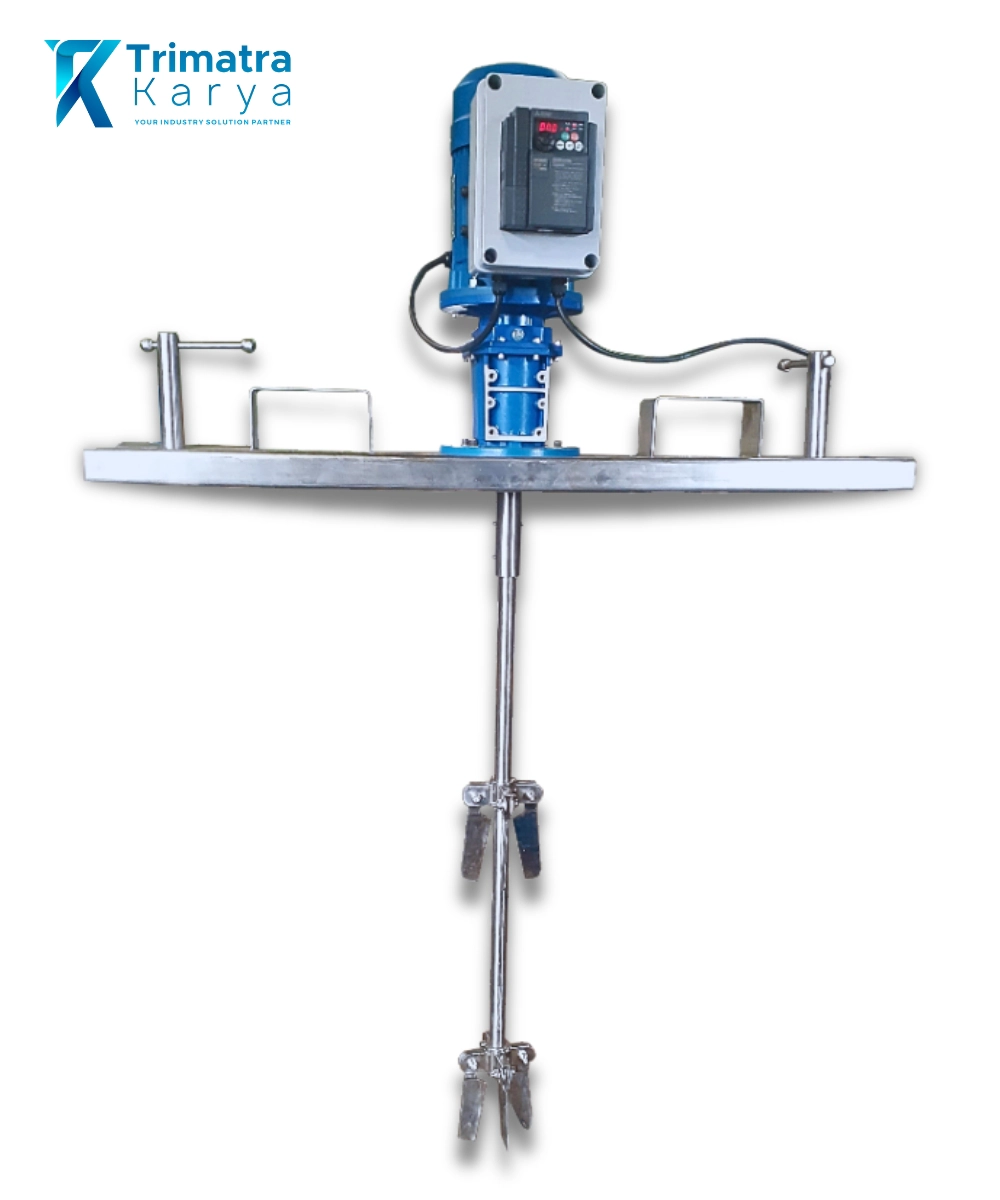
In the industrial world, especially in processes related to mixing, stirring, or homogenizing materials, the agitator mixer plays a crucial role. This device is used to create a uniform mixture of two or more substances, whether liquid, solid, or gas. The agitator mixer is widely used in various industries, including food, pharmaceuticals, chemicals, cosmetics, and many more. This article will discuss the functions, types, and applications of the agitator mixer.
Functions of Agitator Mixer
Agitator Mixer has several main functions, including:
- Material Mixing
The primary function of the agitator mixer is to mix materials until the desired consistency is achieved. For example, in the food industry, this device is used to mix raw ingredients such as flour, sugar, and water to create dough.
- Homogenization
The agitator mixer helps create a homogeneous mixture, ensuring that all components are evenly blended without sedimentation or separation.
- Particle Reduction
Some types of agitator mixers are designed to break down solid particles in liquids, resulting in a smooth suspension.
- Temperature Control
In certain processes, the agitator mixer also functions to evenly distribute heat, such as in heating or cooling processes.
Types of Agitator Mixers
Agitator Mixers come in various types, tailored to meet different industrial needs. Below are some of the most common types:
- Propeller Agitator
This type uses a propeller to create liquid flow. Propeller agitators are suitable for low- to medium-viscosity liquids, such as water or oil.
- Turbine Agitator
A turbine agitator uses a turbine to generate stronger flow. It is commonly used for mixing high-viscosity liquids or processes that require intensive mixing.
- Paddle Agitator
A paddle agitator uses flat or curved blades to stir materials. This type is ideal for thick or semi-solid liquids, such as dough or paint.
- Anchor Agitator
An anchor agitator has a shape resembling an anchor and is used to stir materials with very high viscosity, such as pastes or resins.
- Magnetic Agitator
A magnetic agitator uses magnets to drive a stirring bar inside a container. This type is commonly used in laboratories to prevent contamination.
- Helical Agitator
A helical agitator features spiral-shaped blades to mix high-viscosity materials, such as bread dough or thick chemicals.
Applications of Agitator Mixers in Industry
Agitator Mixers have a wide range of applications across various industries. Here are some examples of their uses:
- Food and Beverage Industry
Agitator mixers are used to mix raw ingredients such as flour, sugar, milk, and other components in the production of bread, cakes, sauces, and beverages.
- Pharmaceutical Industry
In drug manufacturing, agitator mixers are used to blend chemicals, create suspensions, or mix liquids in the production of syrups and tablets.
- Chemical Industry
Agitator mixers are used for mixing chemicals, controlling chemical reactions, or creating homogeneous mixtures in the production of paints, resins, and other chemical products.
- Cosmetic Industry
In the production of cosmetics such as creams, lotions, and lipsticks, agitator mixers are used to blend ingredients to achieve the desired texture.
- Mining Industry
Agitator mixers are used in mineral processing, such as mixing chemicals with ores or stirring slurry.
- Water Treatment Industry
Agitator mixers are used in wastewater treatment to mix chemicals with water or stir sludge.
Choosing the Right Agitator Mixer
Selecting the appropriate agitator mixer should be based on the specific requirements of the production process. Several key factors to consider include:
- Material Viscosity
Materials with high viscosity require a more robust type of agitator, such as a paddle or anchor agitator.
- Material Volume
The capacity of the mixing vessel also affects the choice of agitator size and type.
- Type of Material
Corrosive or abrasive materials require an agitator constructed from durable materials, such as stainless steel.
- Mixing Speed
Processes that require rapid mixing need a high-speed agitator, such as a turbine or propeller agitator.
Conclusion
Agitator mixers play a crucial role in various industries to ensure efficient and effective mixing, stirring, or homogenization processes. By understanding their functions, types, and applications, industries can select the right agitator mixer to enhance product quality and production efficiency. In an increasingly modern industrial era, the role of agitator mixers will continue to evolve in response to the demand for faster, more precise, and high-quality production processes.
FAQ (Frequently Asked Questions About Agitator Mixer)
- Agitator Mixer
Used for general mixing of materials, either at low or high speeds.
- Homogenizer
Used to mix materials at a microscopic level to achieve a very fine and uniform distribution.
Agitator Mixers from Trimatra Karya are made of stainless steel SS 304 and SS 316, which are corrosion-resistant, food-grade, and meet BPOM and GMP standards.
The choice of an Agitator Mixer depends on:
- The type of material being mixed (liquid, solid, high viscosity, etc.)
- The volume and capacity of the mixing tank
- The required mixing speed and intensity
- Specific industrial applications
- Clean regularly to prevent residue buildup.
- Use appropriate cleaning agents for stainless steel.
- Check bearings and seals periodically to prevent leaks.
- Ensure the motor and gearbox are in optimal condition.
Yes, some Agitator Mixer models are designed to withstand high temperatures and aggressive chemicals, especially those made of stainless steel SS 316.
Choose a High-Quality Agitator Mixer
If you need a high-quality Tank Mixer for your industrial needs, make sure to choose products that meet safety and quality standards, such as stainless steel SS 304 or SS 316, and are certified by BPOM and GMP. At Trimatra Karya, we offer various types of Tank Mixers tailored to your requirements. Contact us at +62 813 1344 8497 or 022-0877-74830 for more information.




Adi Reply
Thank you, the article is very helpful.